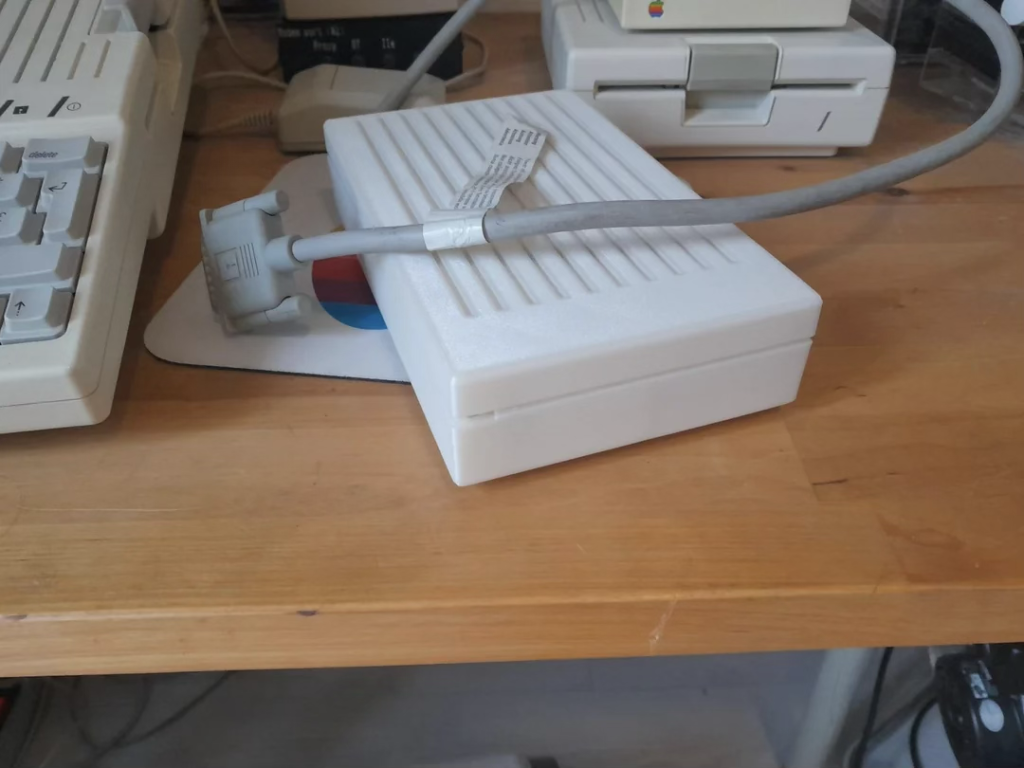

Finally, there is a daisy-chainable smartport MicroSD hard drive that lets Apple II users have their cake (and Floppies) too.


In the Apple retro computing realm, few frustrations run deeper than the eternal trade-off on an Apple IIc: massive storage or your trusty floppy drives? You always had to pick one, that is until now. Entering into the fray is the new BurgerDisk, the brainchild of Apple II legend Colin Leroy-Mira, a sleek, a fully open-source SmartPort based hard drive that slides right into your daisy chain like it was always meant to be there.
Launched on Kickstarter on January 31, 2026, this tiny powerhouse is already funded and shipping in April, promising to breathe new life into one of computing’s most beloved platforms.
From Shufflepuck Café to Hardware Hero
Colin Leroy-Mira isn’t new to the Apple II scene. He’s the developer behind Shufflepuck Café, the air-hockey classic game that still gets played on emulators and original hardware by a number of folks in the community. But like many Apple II enthusiasts, he hit a wall with storage. “I wanted some storage space on the Apple //c to be able to save more of my Quicktake pictures, and easily organize my documents,” he explains on his project site. “I also wanted to be able to still boot from the internal floppy disk drive, and have access to the external floppy disk drives.”
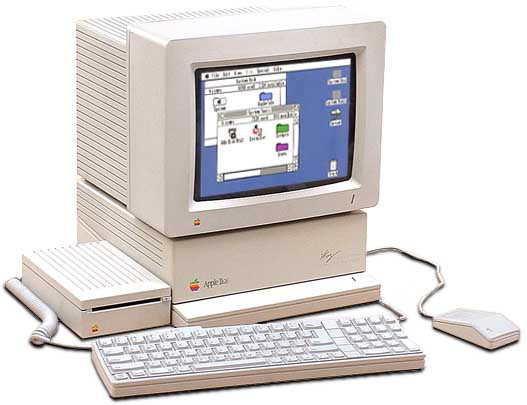
Existing SmartPort SD adapters forced users to choose: swap out your floppy chain for gigabytes of modern storage, or stick with 140 KB floppies forever. BurgerDisk changes the game. It’s fully daisy-chainable—plug it anywhere in the SmartPort chain (even in the middle) and keep your Unidisk 3.5″, Disk //c, or other peripherals humming along. No more yanking cables. No more compromises.
Specs That Speak Retro Volumes
- Storage: Up to four ProDOS volumes per microSD card, each configurable from 140 KB (floppy-sized) to a generous 32 MB. Total capacity? Whatever your SD card holds—plenty for documents, games, and QuickTake photos.
- Interface: Standard DB-19 SmartPort connector with full daisy-chain support. Works as the first device, last device, or anywhere in between.
Compatibility: Natively tested on ROM 3 and ROM 4x IIc, ROM 01 IIgs, and IIe systems with SoftSP or 665-0101 cards. It plays nice with most setups—though Colin notes some SoftSP quirks with certain 3.5″ drives. - Firmware: Open-source GPLv3 (with MIT-licensed chunks from SmartportSD). Configure via a simple config.txt on the microSD root—list your .po image filenames, add debug=1 if you want, and you’re done. No LCD, no buttons, no fuss—just reliable boot-from-floppy-plus-mass-storage bliss.
Hardware: Compact PCB with AVR microcontroller, microSD slot (now conveniently front-mounted on the latest revision), and 3D-printable enclosure that looks right at home next to your beige Apple gear. Black enclosure option available for that perfect “Darth Vader” II Plus aesthetic. - Everything—schematics, Gerbers, firmware source, build instructions, and a detailed user manual—is on GitHub under permissive licenses (CC BY-SA for hardware). Want to mod it? Sell your own? Go for it—just share the files.


Kickstarter: Small Goal, Big Impact
The campaign is refreshingly modest: just €1,000 to cover initial production. It hit that target within just days of launching on January 31, 2026, and as of late February is cruising toward its March 2 close. Backers can snag:
- Fully assembled white BurgerDisk + cable + DB-19 connector: €120
- Black “Darth Vader” edition: €130
- DIY kits, bare enclosures, and microSD cards as add-ons
- Shipping to the U.S. adds about €65 (tariffs are real, folks).
- Delivery is slated for April 2026—fast for a niche hardware project.
Why It Matters
In an era of numerous emulators and FPGA recreations, why bother with original Apple II hardware? Because the feel of it is irreplaceable. The click of a real floppy door, the glow of an original monitor, the satisfaction of a system you can open, tweak, and truly own. BurgerDisk preserves that feeling while solving the one point of pain that’s kept many machines collecting dust: storage.
It’s also a masterclass in open-source retro hardware. Colin’s transparent development—detailed forum posts on TinkerDifferent and 68kMLA, assembly videos, exhaustive testing notes—invites the community to participate, improve, and spin off new ideas. Pin-compatible with popular SPIISD boards? Firmware drops that fix long-standing bugs? That’s the spirit that keeps these 40-plus-year-old computers alive.


The Bottom Line
If you own an Apple IIc, IIgs, or any SmartPort-equipped system and have ever muttered “I just want more space without losing my floppies,” BurgerDisk is the answer you’ve been waiting for. Small, smart, and gloriously open-source, it’s not just a storage solution—it’s a love letter to the platform that launched a million programmers.
Head to Kickstarter before March 2 to support the project and secure yours. And once it arrives? Fire up A2Desktop, copy that floppy library over, and remember why we fell in love with these machines in the first place.
BurgerDisk: Because even in 2026, some disks are still worth flipping.